

The OTC FD19-VC4 - The First True Welding Cobot
The FD19-VC4 (and its long-reach variant, the FD19-VC4L) is the first cobot OTC has developed from the ground up for welding. IP65-protected, TIG-capable, and programmed in just a few steps, for companies looking to get started with automation without their own robotics or welding experts.
First Welding Cobot
The only cobot developed from the ground up for welding.
IP65-Protected
Dust and splash-water protected, eliminating the need for an additional protective cover.
High Path Accuracy
Max. plus/minus 0.15 mm per ISO 9283, at industrial robot level.
Easy Programming
Ready to use without dedicated welding or robotics experts on the team.
Full OTC Compatibility
Directly compatible with the entire OTC welding technology portfolio.
Programming Made This Simple
The video shows how the FD19-VC4 is programmed with the PhotoTeach app in three steps. The operator takes a photo of the component using an iPad Pro with a LiDAR sensor, selects the weld seam on the screen, and transfers the program to the robot controller at the touch of a button. The robot automatically calculates the optimal torch position, torch angle, and touch-sensor search, with no programming knowledge required.
OTC FD19-VC4: Programming with PhotoTeach in 3 Steps
The Ideal Welding Cobot for Production
The OTC FD19-VC4 is the first cobot specifically developed for welding. Unlike retrofitted cobot solutions, it comes with the complete OTC welding technology built in from the factory, featuring a shared controller for robot and welding equipment, a splash-water-protected housing, and signal shielding that works reliably even with TIG welding. This makes it possible for companies without their own robotics specialists to get started with automated production.

OTC FD19-VC4 and VC4L
Compatible with the OTC Welding Technology and Sensor Portfolio
Enables an easy entry into automation thanks to intuitive teach-in and visual programming.
Three Ways to Program the FD19-VC4
Other cobot manufacturers require two devices and two programming steps for welding applications: guiding the arm and setting the welding parameters separately. The FD19-VC4 has the welding controller integrated. Programming happens in a single step.
Free Drive
The operator releases the brakes and guides the arm by hand along the weld seam. The most intuitive method for simple components and quick prototypes, with no training or additional software required. Ideal when components change frequently and extensive programming is not worthwhile.
PhotoTeach *
Contactless programming via iPad Pro with LiDAR sensor and the "AR Teach" app. The cobot automatically recognizes the weld seam and calculates torch position, torch angle, and touch-sensor search. The video above shows exactly how this works.
Teach Pendant
Classic programming via the teach pendant, proven for experienced operators and more complex paths. Individual points can be approached precisely and assigned individual welding parameters. The right choice for demanding multi-pass seams that require fine adjustment.
* PhotoTeach requirements:
Apple iPad Pro with LiDAR sensor, FD19 robot controller, PhotoTeach app "AR Teach"
Note: The MWX 3501 TIG torch is currently not supported by PhotoTeach; only Free Drive or Teach Pendant are available for it.
Technology in Detail
High Path Accuracy
Optimal for welding applications with precision at industrial robot level.
High Interference Resistance
Optimal protection of the control electronics against electromagnetic interference for maximum process stability.
Protection and Durability
Meets the IP65 standard and reliably protects against heat, UV radiation, and weld spatter.
Full OTC Compatibility
Compatible with OTC industrial robot accessories, welding equipment, and sensors.
One Technology, Two Ranges
The welding-ready cobot impresses with:
- splash-protected design
- easy programming
- high precision through optimized axes.

Compared to the VC4, the VC4L offers a significantly greater reach and is ideal for flexible use across multiple stations. Despite the extended range of motion, the robot remains compact and mobile.

With its modern design and easy operation, the VC4 is the optimal solution for automated welding production.

Collaborative Design Without Corners or Edges
Light, Small, Easy to Transport
Compared to the smallest OTC industrial robot, the H5 at 58 kg, our VC4 cobot weighs only 37 kg, a 36 percent weight reduction
LED Status Indicator
The VC4 cobot's operating mode is displayed on the top of the second robot axis.
Fully Integrated Cabling Inside the Main Unit
Cabling and compressed air connection are accessible at the 5th axis
Many collaborative robots can move a torch. The FD19-VC4 is designed to guide weld seams with stability: high path accuracy, easy teach-in operation, robust construction, and direct OTC welding integration.
Technical Data
Variant Comparison
Variant | Max. Working Range (P-Point) |
|---|---|
FD19-VC4 | 954 mm |
FD19-VC4L | 1657 mm |
Quick Overview (FD19-VC4)
Feature | Value |
|---|---|
Type | NVC4 |
Design | Vertical, 6-Axis, Articulated |
Max. Working Range (P-Point) | R 954 mm |
Max. Payload | 4 kg |
Mounting Type | Floor (F) |

Axis Data
Axis | Movement | Working Range | Max. Speed | Wrist Additional Load |
|---|---|---|---|---|
1: Rotate | Rotation | plus/minus 170° | 1000 mm/s | n/a |
2: Forward/Back | Swivel | -155° to +90° | 1000 mm/s | n/a |
3: Up/Down | Lift/Lower | -155° to +180° | 1000 mm/s | n/a |
4: Swivel | Rotation | plus/minus 170° | 1000 mm/s | 0,462 kg·m² |
5: Bend | Tilt | -30° to +210° | 1000 mm/s | 0,462 kg·m² |
6: Rotate | Rotation | plus/minus 360° | 1000 mm/s | 0,048 kg·m² |
Equipment
Accessories and Compatibility
The FD19-VC4 is designed from the outset for operation with the OTC portfolio, no modification or third-party interfaces needed.
Equipment | Type | PhotoTeach Compatible |
|---|---|---|
MIG/MAG Torch | RT 3500H | Yes |
MIG/MAG Torch | RTW 5000H | Yes |
Wire Feeder | SynchroFeed Evo Lite | Yes |
TIG Torch | MWX 3501 (MWX C 3501) | No |
Sensors | ARC-Sensor (Software) | Yes |
Sensors | Touch-Sensor (Software and Hardware) | Yes |
Supported welding processes:
CO2/MAG, pulsed MAG, low-spatter, SynchroFeed, TIG.
Additional functions:
touch sensor function, arc sensor function, weaving function, FD-AM welding management system
The FD19-VC4 in Action
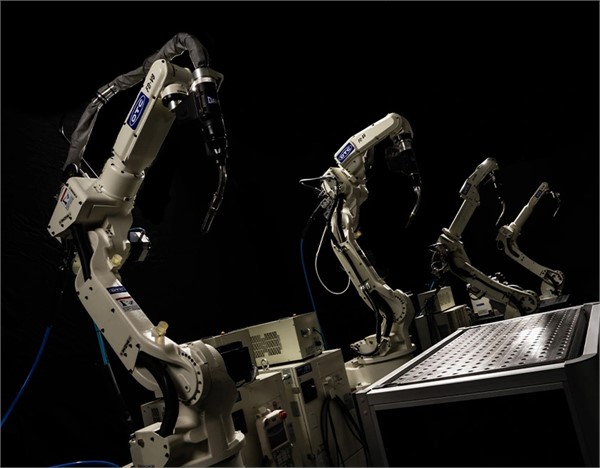
Automating Recurring Seams
Produce components with similar welding tasks reproducibly, without starting from scratch manually every time.
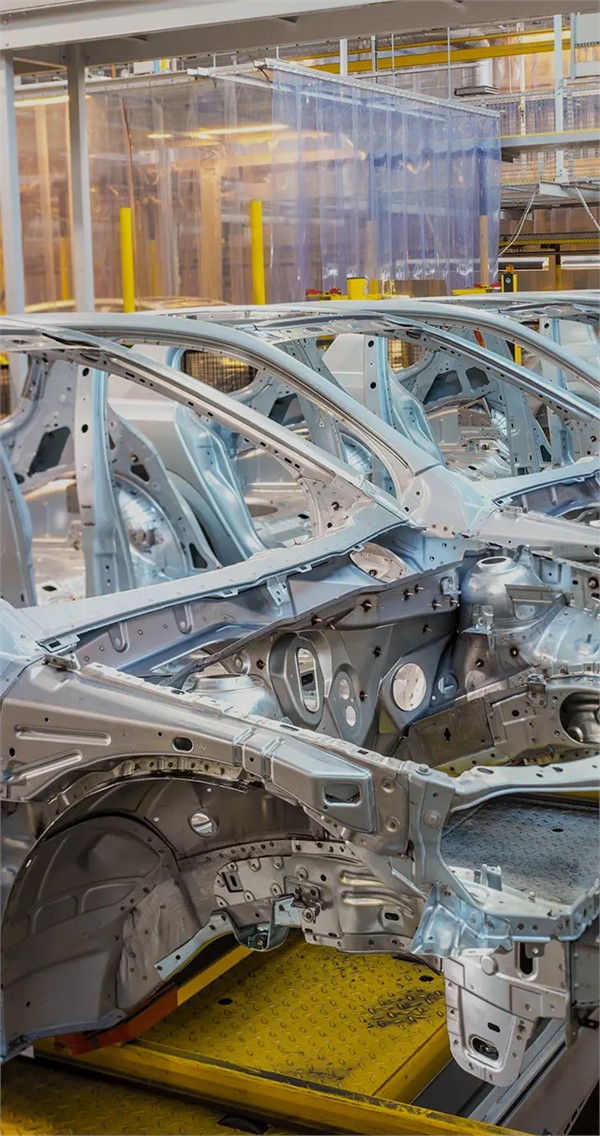
Simplifying Part Changeovers
For companies that weld different parts and do not want to build a rigid, large-scale cell.
Stabilizing Torch Guidance
The FD19-VC4 is designed for arc welding; Daihen specifies 6 axes, 4 kg payload, and plus/minus 0.03 mm repeatability.
In collaboration with OTC, JKS reviews the component, fixture, welding process, safety, and operation, so the FD19-VC4 does not end up as a demo unit but works productively in production.
How Collaborative Is the FD19-VC4 Really?
A cobot is not automatically fence-free in every mode of operation. For the FD19-VC4, we distinguish three scenarios: In teach mode with Free Drive or PhotoTeach, the dead-man's switch is active, operation is collaborative, and no safety fence is required. During automatic movement to the component without a welding process, operation also remains collaborative. During the actual automatic welding process, however, operation is not collaborative. Here, safety distances and personal protective equipment apply, especially eye protection, since the arc, heat, and potentially sharp wire ends pose a risk.
This honest assessment is part of every risk evaluation we carry out together with the customer during integration, including CE conformity for the entire system, not just the cobot alone.
The FD19-VC4 in Action
Not the Right Solution?

FD19-VC8
New Cobot with Higher Payload
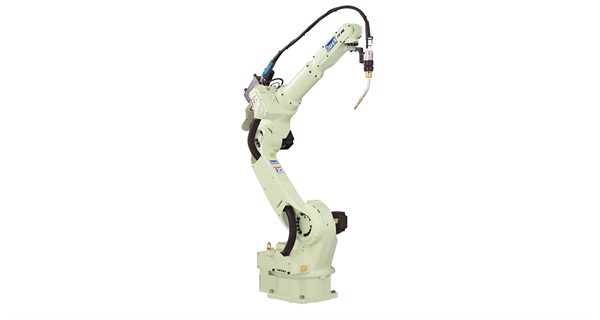
FD Series Industrial Robots
FD-V80, FD-VN166, FD-B4S, and FD19-V210 for series production, larger components, and automated welding lines.
Frequently Asked Questions
A welding cobot is a collaborative robot designed to work alongside people without a continuous safety fence. The FD19-VC4 is the first cobot OTC developed from the ground up for welding, including an integrated welding controller.
Industrial robots are faster but require a safety fence and additional safety technology. The FD19-VC4 is slower, but can be used without a safety fence outside the actual welding process and is easier to program.
In three ways: manually via Free Drive, contactlessly via the PhotoTeach app with iPad Pro and LiDAR, or traditionally via the teach pendant.
Yes. Unlike many other cobots, its high signal shielding makes it reliably usable even for the high-frequency interference signals in TIG welding.
The FD19-VC4 weighs 37 kg, 36 percent lighter than the smallest OTC industrial robot, the H5, and carries up to 4 kg at the end effector.
Yes, the FD19-VC4L offers a 1657 mm working range at the P-point, significantly more than the 954 mm of the standard FD19-VC4. Ideal for longer seams or larger components.
Which Welding Cobot Fits Your Application?
We clarify the component, process, reach, and cycle time, and give you an honest answer on whether the FD19-VC4, the VC4L, or an industrial robot from the FD series is the better solution.